Engineering does not advance merely by solving problems; it advances by transforming the knowledge generated through problem resolution into reusable engineering assets that continuously expand organizational capability.
The real engineering problem is not how specific engineering issues, user requests, or incidents are addressed, mitigated, and resolved by particular individuals, but how the engineering knowledge generated throughout the resolution is systematically captured, preserved, refined, propagated, and reused.
From this perspective, an engineering problem is not fully resolved when its immediate objective has been achieved, but when the engineering knowledge generated throughout its resolution has been systematically validated, and incorporated into the organization’s Engineering Knowledge Hub.
This is precisely the objective of the Engineering Knowledge Management Framework: to provide a conceptual model for creating, preserving, transferring, and evolving engineering knowledge throughout its lifecycle, enabling its future discovery, reuse, refinement, and continuous improvement.
Table of Contents
Introduction
Engineering disciplines have evolved independently over decades, each developing their own terminology, methodologies, frameworks, and tools to address the challenges within their respective domains.
Yet, despite these differences, they consistently converge on remarkably similar engineering principles.
Among the activities of engineering, recurring problems are identified, repeatable solutions are discovered, engineering knowledge is documented, standards are established, processes are improved, repetitive tasks are automated, and engineering tools are built to solve problems more efficiently.
At the center of this continuous evolution lies a resource that often receives less attention than software, infrastructure, or technology itself: engineering knowledge.
People join and leave organizations. Software evolves. Technologies change. Organizational structures are reorganized. Products are redesigned. Yet the engineering knowledge accumulated through years of solving real-world problems remains one of the few organizational assets capable of increasing in value when it is deliberately preserved, shared, refined, and reused.
For this reason, engineering knowledge should be regarded as a valuable asset rather than as a collection of isolated documents, tickets, procedures, source code, or individual experience.
The real engineering problem is not how specific engineering issues, user requests, or incidents are addressed, mitigated, and resolved by particular individuals, but how the engineering knowledge generated throughout the resolution is systematically captured, preserved, refined, propagated, and reused.
From this perspective, an engineering problem is not fully resolved when its immediate objective has been achieved, but when the engineering knowledge generated throughout its resolution has been systematically captured, validated, and incorporated into the organization’s Engineering Knowledge Hub.
This is precisely the objective of the Engineering Knowledge Management Framework: to provide a conceptual model for creating, preserving, transferring, and evolving engineering knowledge throughout its lifecycle, enabling its future discovery, reuse, refinement, and continuous improvement.
This framework presents the current consolidation of that understanding.
The Engineering Knowledge Paradox
Engineering is often measured by its ability to solve problems.
But every solved problem creates something else: engineering knowledge.
Yet after problems are resolved, the generated knowledge often fades away
If engineering continuously generates knowledge, why doesn’t every recurring problem become progressively easier to understand, diagnose, and resolve?
How can engineering knowledge be captured, preserved, organized, validated, shared, applied, and continuously improved as a reusable engineering asset?
These questions led to the development of the Engineering Knowledge Management Framework—a conceptual model that examines how engineering knowledge generated through engineering activities can be transformed into a reusable engineering asset.
Within this context, transient communication transfers information between individuals, whereas engineering knowledge management transforms engineering experience into persistent, reusable organizational capability.
Conversations facilitate collaboration and coordinate people around a particular problem; however, the resulting information represents only an initial input to knowledge management and, unless it is refined, structured, and made reusable, it does not consistently contribute to the organization’s ability to solve similar problems in the future.
Traditionally, support engineering relies either on the accumulated experience of individuals obtained through prolonged exposure to organization-specific systems and environments, or on the individual ability to rapidly integrate understanding across systems, processes, and business domain contexts to resolve domain-specific, critical, and time-sensitive problems.
In contrast, Engineering Knowledge Management transforms individual knowledge and experience into organizational capability, enabling knowledge to scale beyond individuals and improving problem resolution through faster, more accurate solutions while reducing unintended impacts.
The Engineering Knowledge Management Framework is founded on a simple premise: every engineering activity inherits engineering knowledge from the past and produces engineering knowledge for the future. The engineering outcome solves today’s problem; the engineering knowledge it creates becomes part of the foundation upon which future engineering is built.
The chapters that follow explore the concepts, lifecycle, principles, and mechanisms through which engineering knowledge evolves into long-term engineering capability.
Roadmap
The Engineering Knowledge Management Framework did not emerge as a theoretical model from the outset. It gradually evolved while addressing practical challenges encountered in production engineering and day-to-day engineering operations, together with the broader question of how engineering knowledge generated through those activities could be systematically preserved, refined, and reused.
The initial motivation for these ideas emerged while exploring the design of the ZupportL5 System. The original objective was to improve support engineering by capturing operational experience and making it reusable.
As those ideas matured through continuous reflection and refinement, it became evident that the original software requirements were expressing a broader engineering concept: Engineering Knowledge Management.
The ZupportL5 lema was: “Elevating Support Engineering to the Next Level: L5 — Simplifying Resolutions”
The Engineering Knowledge Management Framework extends this idea through a broader principle: “Engineering Knowledge as a Management Asset“.
A subset of the ZupportL5 user stories that motivated this framework is included in Appendix A — Original Motivation: ZupportL5 User Stories . The current implementation and ongoing evolution of the ZupportL5 System are available in the ZupportL5 GitHub repository, ZupportL5 Documentation.
The chapters in this document are not independent discussions but complementary views of a single Engineering Knowledge Management Framework. Each chapter explores a different dimension of how engineering knowledge is created, transformed, operationalized, and continuously improved.
The framework is organized into four complementary layers:
- Conceptual Layer — Why engineering knowledge exists and why it should be treated as a strategic engineering asset.
- Operational Layer — How engineering activities generate, consume, and refine knowledge through daily operations.
- Knowledge Layer — How knowledge is captured, validated, managed, and continuously evolved.
- System Layer — How the Engineering Knowledge Management Framework can be operationalized through an Engineering Knowledge Hub that integrates engineering knowledge, engineering artifacts, automation, and AI-assisted capabilities. ZupportL5 represents one possible implementation of this layer.
Together, these layers describe a continuous engineering framework in which engineering activities generate organizational knowledge, organizational knowledge becomes engineering practice, and engineering practice becomes organizational capability
For the purposes of this document, an Engineering Knowledge Management Framework is defined as a structured model that integrates engineering principles, operational processes, knowledge management practices, and platform capabilities into a unified approach for creating, preserving, and continuously improving engineering knowledge.
EnK²A → Engineering Knowledge as a Management Asset
ENKMF → Engineering Knowledge Management Framework
Part I — The Engineering Problem
I.1. Engineering Problem Resolution
When Is an Engineering Problem Truly Solved?
Engineering continuously addresses production incidents, software defects, infrastructure failures, deployment issues, domain-specific user requests, operational tasks, and both new and previously encountered engineering problems.
From an operational perspective, the objective is clear:
- Assess the impact.
- Mitigate the issue.
- Restore normal operation.
- Close the ticket
However, from an engineering perspective, resolving the incident is only part of the process.
Every investigation produces engineering knowledge:
- Root causes
- Observations
- Workarounds
- Better procedures
- Design improvements
- Operational experience
Without preserving that knowledge, previous experience cannot be systematically reused.
An engineering problem is therefore not completed when the ticket is closed, but when the knowledge generated during its resolution has been validated, propagated, and incorporated into the organization’s Engineering Knowledge Hub.
Operational vs. Engineering Completion
Operational Completion:


Engineering Completion:

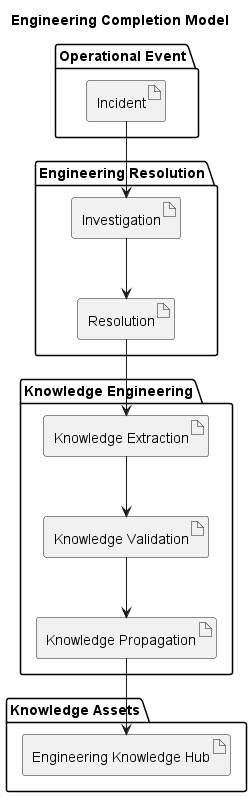
Fundamental Questions
If an engineering problem is not truly resolved until the knowledge generated throughout its resolution becomes part of the organization’s engineering capability, fundamental questions arise:
- What constitutes engineering knowledge?
- Why is engineering knowledge frequently lost despite being continuously generated?
- How is engineering knowledge created through engineering activities?
- How can engineering knowledge be systematically created, captured, preserved, validated, transferred, organized, shared, applied, and continuously improved?
- How does engineering knowledge evolve throughout its lifecycle?
- How do engineering practices emerge from engineering knowledge?
- How do engineering artifacts preserve, communicate, and operationalize engineering knowledge?
- How does engineering knowledge become organizational engineering capability?
- How can engineering knowledge reduce future engineering effort while improving reliability, consistency, and scalability?
- How does the continuous evolution of engineering knowledge enable continuous improvement?
The Engineering Knowledge Management Framework presented in this work seeks to provide a conceptual model that integrates the principles, practices, artifacts, and processes involved in answering these questions and managing engineering knowledge throughout its lifecycle.
Throughout this work, operationalized refers to the process by which engineering knowledge is transformed from documented or implicit knowledge into an integral part of engineering activities.
Once operationalized, knowledge no longer exists only as information—it actively guides decisions, defines processes, supports execution, and can ultimately be standardized and automated.
I.2. Engineering Knowledge as a Valuable Asset
Why Is Knowledge an Asset?
Organizations invest heavily in infrastructure, software, automation, human resources, and technology.
Yet one of their most valuable assets is generated continuously as a consequence of engineering itself:
Engineering Knowledge.
Unlike physical assets, engineering knowledge does not diminish through use. Every time it is reused, refined, validated, and shared, its value expands—extending its applicability, increasing its coverage, strengthening its reliability, and enriching the collective engineering capabilities of the organization.
- Technology changes.
- Products evolve.
- People change roles.
- Organizations reorganize.
Engineering knowledge remains the mechanism that allows organizations to continuously improve, and ultimately to operate with resilience, coherence, purpose, and sustainability.
Engineering knowledge should therefore be regarded as a valuable organizational asset rather than as isolated documentation distributed across tickets, source code, chat conversations, procedures, or individual experience.
Evolution of Organizational Knowledge


Knowledge only becomes an organizational asset when it can be discovered, understood, reused, and continuously improved.
I.3. Engineering Practices
What Is an Engineering Practice?
Engineering progresses by solving recurring problems.
Over time, successful solutions are repeated, refined, validated, and eventually recognized as better ways of working.
These become Engineering Practices.
Engineering practices represent the collective knowledge accumulated through the contributions of countless individuals who, through repeated observation, refinement, and validation, discovered more effective ways to solve problems. Over time, these approaches become documented as Engineering Practices and eventually evolve into Standards.
- Engineering practices are not software tools.
- Engineering practices are not documents.
- Engineering practices are not automation.
- They are abstractions of validated engineering knowledge.
- Documentation communicates practices.
- Standards institutionalize practices.
- Automation executes practices.
- Engineering tools automate practices.
Evolution of an Engineering Practice
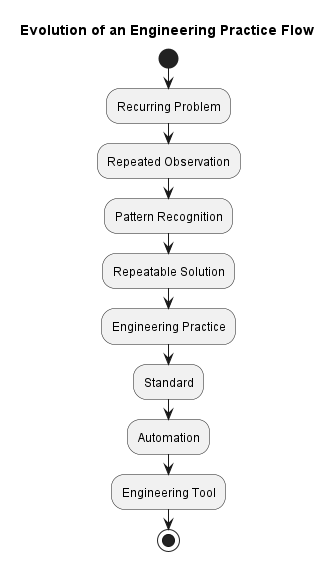

This evolution explains why engineering continuously advances.
Every successful engineering abstraction enables future engineering to solve problems more consistently, efficiently, and at greater scale.
Part II — Engineering Knowledge Foundations
II.1. Engineering Knowledge Taxonomy
How Is Engineering Knowledge Classified?
Engineering practices are abstract. They define how recurring engineering problems are solved but do not, by themselves, provide a tangible means for communicating or preserving that knowledge.
To establish a common vocabulary, this framework classifies engineering knowledge into three complementary categories: engineering knowledge assets, engineering knowledge artifacts, and engineering knowledge capabilities. Together, these categories describe what engineering knowledge is, how it is represented, and how it is created, managed, and applied throughout its lifecycle.
Engineering Knowledge Assets
Engineering knowledge assets are reusable bodies of engineering knowledge that possess enduring organizational value. They represent the knowledge an organization intentionally preserves because it contributes to its engineering capability over time.
Definition
Engineering Knowledge Asset: A reusable body of engineering knowledge that contributes to an organization’s capability to design, build, operate, maintain, or improve engineering systems.
| Engineering Knowledge Asset | Purpose |
|---|---|
| Engineering Practice | Defines how recurring engineering problems are solved. |
| Knowledge Base | Preserves and organizes reusable engineering knowledge for discovery and reuse. |
Engineering Knowledge Artifacts
Engineering knowledge assets become reusable through artifacts, which transform abstract engineering knowledge into tangible representations that can be consistently shared, reviewed, versioned, maintained, and applied across engineering teams. By decoupling knowledge from its original contributors, artifacts enable engineering knowledge to persist, evolve, and remain accessible throughout the engineering lifecycle..
Definition
Engineering Knowledge Artifact: A tangible representation of engineering knowledge created to document, communicate, preserve, govern, or implement engineering knowledge.
| Artifact | Purpose |
|---|---|
| Guideline | Recommends preferred approaches. |
| Guide | Explains concepts and procedures. |
| Handbook | Organizes engineering knowledge within a domain. |
| Runbook | Provides executable operational procedures. |
| Playbook | Coordinates responses across multiple scenarios or teams. |
| Postmortem | Captures lessons learned after significant events. |
| Architecture Decision Record (ADR) | Preserves important engineering decisions. |
| Standard | Institutionalizes validated engineering practices. |
| Source Code | Implements engineering knowledge. |
Although these artifacts differ in purpose, they all represent different forms of engineering knowledge.
Engineering Knowledge Capabilities
Engineering knowledge capabilities are the organizational mechanisms that enable engineering knowledge to be created, managed, validated, applied, automated, and continuously improved. They transform engineering knowledge into organizational capability.
Definition
Engineering Knowledge Capability: An organizational capability that enables the creation, management, application, automation, or continuous improvement of engineering knowledge.
| Engineering Knowledge Capability | Purpose |
|---|---|
| Engineering Tool | Automates or supports engineering practices and workflows. |
| Knowledge Management Process | Governs the lifecycle of engineering knowledge from creation through continuous improvement. |
| Knowledge Discovery Mechanisms | Identify, extract, validate, and transform engineering knowledge into reusable organizational assets. |
Relationship Between the Categories
Engineering practices define how recurring engineering problems are solved. Engineering artifacts embody and communicate those practices, while engineering capabilities enable their application, governance, automation, and continuous improvement.
Together, these categories provide a comprehensive classification of engineering knowledge by distinguishing its organizational value (assets), representation (artifacts), and enablement (capabilities).
- Engineering knowledge assets define what possesses enduring organizational value.
- Engineering knowledge artifacts define how engineering knowledge is represented, documented, communicated, preserved, and implemented.
- Engineering knowledge capabilities define how engineering knowledge is created, managed, applied, automated, and continuously evolved.

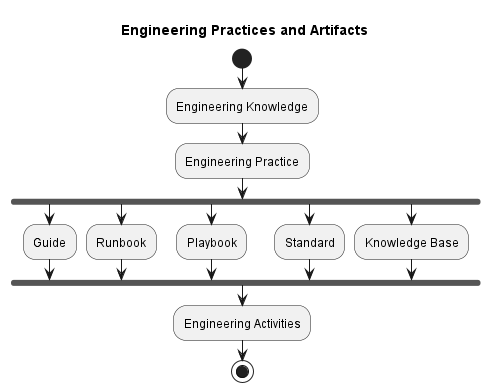
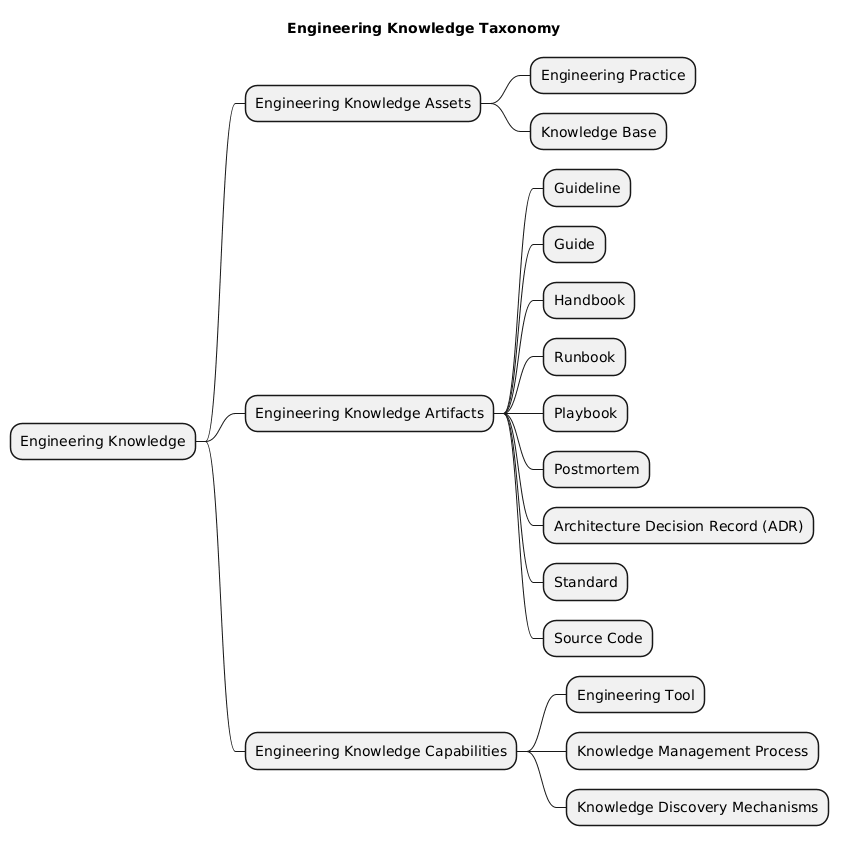

Together, they establish the conceptual foundation of the Engineering Knowledge Management Framework and provide a consistent taxonomy for describing engineering knowledge throughout its lifecycle.
II.2. Engineering Knowledge Management Lifecycle
How Does Engineering Knowledge Evolve? (Knowledge Lifecycle)
Engineering knowledge is continuously generated throughout engineering activities.
Without a structured lifecycle, valuable knowledge becomes fragmented across systems, documents, tickets, conversations, and individual experience.
Engineering Knowledge Management provides the process through which engineering knowledge is continuously improved.
Engineering Knowledge Lifecycle
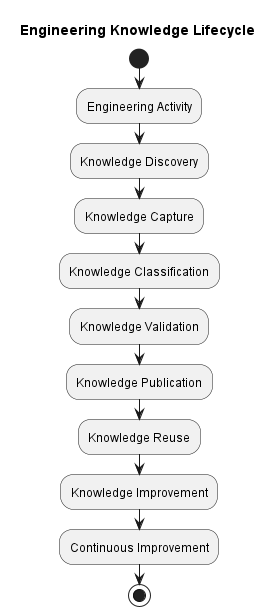
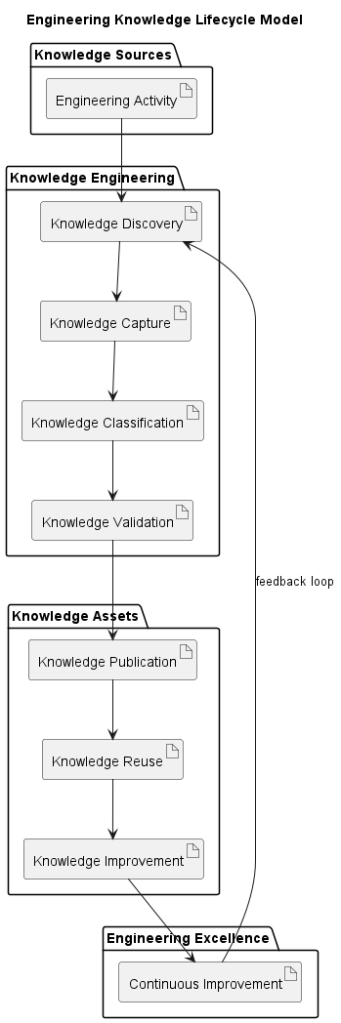
Each phase of the Engineering Knowledge Management Lifecycle transforms engineering experience into increasingly reusable organizational capability.
Together, these phases establish a continuous process in which knowledge is systematically identified, structured, validated, shared, applied, and refined, ensuring that engineering experience extends beyond individual activities and contributes to the organization’s long-term engineering capability.
| Phase | Description | Input | Output |
|---|---|---|---|
| Engineering Activity | Engineering work generates experience through design, implementation, operation, maintenance, troubleshooting, or analysis. | Engineering work | Engineering experience |
| Knowledge Discovery | Identify engineering experience that has long-term organizational value. | Engineering experience | Identified knowledge |
| Knowledge Capture | Transform engineering experience into explicit and reusable knowledge artifacts. | Identified knowledge | Knowledge artifacts |
| Knowledge Classification | Organize knowledge using categories, metadata, relationships, and domains. | Knowledge artifacts | Structured knowledge |
| Knowledge Validation | Verify that knowledge is technically correct, complete, consistent, and reusable. | Structured knowledge | Validated knowledge |
| Knowledge Publication | Make validated knowledge accessible through organizational knowledge repositories. | Validated knowledge | Published knowledge |
| Knowledge Reuse | Apply published knowledge to solve engineering problems more efficiently and consistently. | Published knowledge | Improved engineering outcomes |
| Knowledge Improvement | Refine knowledge using new engineering experience, lessons learned, and evolving practices. | Reused knowledge and new experience | Improved knowledge |
Each engineering activity contributes to the Engineering Knowledge Hub.
Likewise, each future engineering activity benefits from the accumulated knowledge already preserved within the hub.
The lifecycle therefore forms a continuous feedback process rather than a one-time documentation effort.
II.3. Engineering Knowledge Responsibility Model
Engineering knowledge does not emerge from a single role or activity; it is the result of coordinated contributions across different support domains. Each role contributes according to its proximity to the problem, domain expertise, and responsibility within the engineering lifecycle.
Defining these responsibilities ensures that valuable experience is not only captured but transformed, validated, maintained, and evolved as organizational capability.
The following paragraphs define the knowledge contribution responsibilities of each role according to the proposed Engineering Knowledge Framework.
Business Users, Data Stewards and Business Domain Experts
Business domain users represent the source of business knowledge required for understanding processes, operational objectives, data meaning, and expected system behavior.
Within the Engineering Knowledge Framework, they should contribute domain knowledge by providing:
- Business process context
- Functional requirements
- Data definitions and interpretation rules
- Expected application behavior
- Business impact assessment
- Validation of functional solutions
Their role is not to manage technical solutions, but to provide the business knowledge required for engineering teams to correctly analyze, design, and validate system changes.
Framework Contribution:
Generate and validate business knowledge assets that provide context for incidents, system behavior, data interpretation, and application evolution.
Engineering Support / Production Engineering / Site Reliability Teams
Engineering Support represents the operational engineering function responsible for maintaining service reliability and transforming operational experience into reusable engineering knowledge.
Within the Engineering Knowledge Framework, they should capture and formalize knowledge generated during:
- Incident investigation
- Service request resolution
- Troubleshooting activities
- Root cause analysis
- System behavior analysis
- Operational improvements
Their contribution should include the creation and maintenance of:
- Troubleshooting guides
- Runbooks
- Operational procedures
- Known issue documentation
- Incident knowledge records
- Root cause analysis documentation
When issues require application-level changes, Engineering Support should provide Application Development teams with technically enriched information, including investigation results, evidence, impact analysis, and identified causes.
Framework Contribution:
Transform operational problem-solving experiences into engineering knowledge assets that improve reliability, reduce repeated effort, and enable knowledge reuse.
Application Development / Application Engineering Teams
Application Development owns the software systems, including source code and product functionality.
Within the Engineering Knowledge Framework, they should contribute knowledge generated from:
- Code changes
- Defect resolution
- Application enhancements
- Product Feature Requests
- Database modifications
- Design decisions
- Release activities
Their knowledge contributions should include:
- Technical documentation
- Design decisions
- Release information
- Change impact documentation
- Application behavior updates
Application Development should also review and enrich knowledge captured from production issues when system changes are required.
Framework Contribution:
Transform software evolution activities into technical knowledge assets that preserve system understanding and support future engineering activities.
Engineering Knowledge Governance
Knowledge Governance defines the structure, standards, and lifecycle required to maintain engineering knowledge as an organizational capability.
Within the framework, governance should establish:
- Knowledge classification models
- Ownership responsibilities
- Validation processes
- Review cycles
- Publication standards
The governance function ensures that knowledge generated from business operations, production support, and software development activities becomes structured, accessible, and continuously improved.
Framework Contribution:
Enable the transformation of individual experience and project-specific information into sustainable organizational engineering knowledge.
Therefore, engineering knowledge is generated through engineering activities, transformed through engineering understanding, and sustained through engineering ownership.
Effective knowledge management depends not only on preserving information, but on continuously transforming engineering experience into reusable organizational capability
II.4. Continuous Improvement Through Engineering
Why Does Engineering Continuously Evolve? (Closed-Loop & Recursive Evolution)
Engineering continuously evolves.
Every solved problem contributes to future engineering capability.
As repeatable solutions emerge, they become engineering practices.
Once practices have demonstrated consistency, they become suitable candidates for automation.
Automation enables engineering to address larger systems, higher volumes, and increasingly complex challenges.
Those new capabilities inevitably introduce new engineering problems.
The cycle then repeats.
Recursive Evolution of Engineering

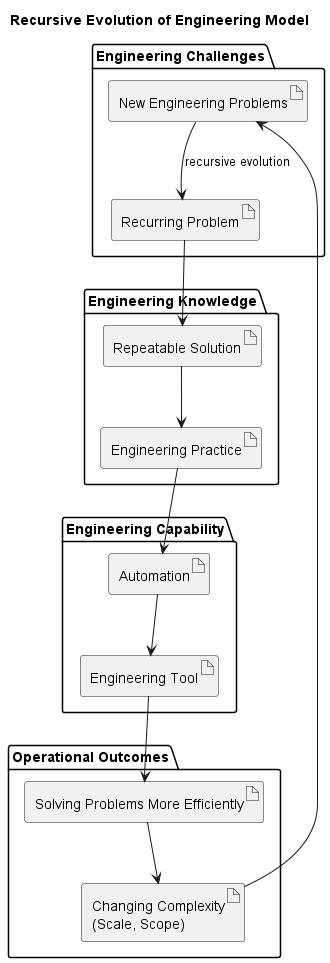
Software engineering is recursive in the sense that it evolves through a closed-loop continuous improvement process.
- Engineering solves problems.
- Repeatable solutions become engineering practices.
- Engineering practices can be automated.
- The resulting software becomes the next generation of engineering tools, enabling engineering to solve increasingly complex problems.
- Every successful engineering abstraction expands the frontier of what engineering can address.
- That expanded frontier inevitably creates the next generation of engineering problems.
Engineering evolution is recursive: every capability developed to solve existing problems transforms the operational environment, creating new challenges that drive the next generation of engineering knowledge and capability.
Part III — Generalization of the Framework
III.1 Universal Engineering Lifecycle
How can the Engineering Knowledge Management Framework be applied across different engineering disciplines?
Although the engineering inputs differ across disciplines, the lifecycle of engineering knowledge remains fundamentally the same.
Whether the work begins with a software requirement, an operational incident, a system integration issue, a network change, or a security vulnerability, the engineering objective extends beyond achieving the immediate operational result.
It also includes transforming the knowledge generated during that work into a reusable organizational asset that strengthens future engineering capabilities.
This observation suggests that the Engineering Knowledge Management Framework is not limited to Operations or Site Reliability Engineering.
Rather, it describes a general engineering principle that can be applied across multiple engineering disciplines.
The common engineering lifecycle can be summarized as follows:
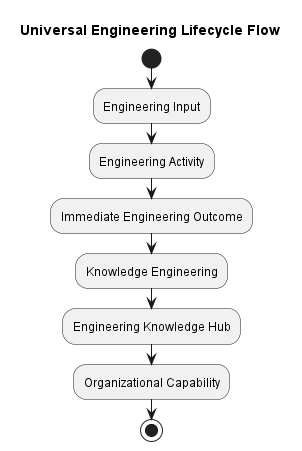

The nature of the engineering input varies according to the discipline, while the remainder of the lifecycle remains essentially unchanged.
| Engineering Discipline | Typical Engineering Input |
|---|---|
| Software Engineering | Requirements, user stories, design specifications |
| Systems Engineering | Change requests, system requirements, integration issues |
| Network Engineering | Connectivity issues, capacity planning, configuration changes |
| Security Engineering | Vulnerabilities, incidents, compliance findings |
| Support Engineering | User requests, support tickets, product defects, customer-reported issues |
| Site Reliability Engineering | Incidents, alerts, operational events, service degradations |
From this perspective, Engineering Knowledge Management is not an operational discipline but an engineering discipline. The source of the work may differ, but the lifecycle through which engineering knowledge is created, validated, preserved, shared, and reused remains fundamentally the same.
This perspective also clarifies the role of the Engineering Knowledge Hub. It should not be viewed as an incident management repository or a documentation platform, but as the organizational mechanism through which engineering knowledge from diverse disciplines is integrated, preserved, and transformed into reusable organizational capability.
Ultimately, this framework shifts the engineering perspective from asking “How do we solve engineering problems?” to asking “When is an engineering problem truly solved?”
Within this framework, an engineering problem is considered fully resolved only when the knowledge generated during its resolution has been integrated into the Engineering Knowledge Hub, where it becomes discoverable, reusable, and capable of contributing to future engineering activities and continuous organizational improvement.
Regardless of the engineering discipline or the origin of the engineering work, the lifecycle through which engineering knowledge is created, validated, preserved, shared, and reused remains fundamentally the same. Only the engineering inputs differ.
III.2 Engineering Knowledge Across Domains
The transformation of engineering experience into organizational capability is not exclusive to software engineering. Across engineering disciplines, execution activities generate observations, deviations, failures, and improvement opportunities that must be captured, analyzed, and transformed into reusable knowledge.
Manufacturing disciplines have long applied this principle through mechanisms such as test findings, defect reports, non-conformance records, corrective actions, and lessons learned. These practices demonstrate a fundamental engineering pattern:
Production Execution → Abnormality Detection → Problem Identification → Root Cause Analysis → Knowledge Capture → Kaizen Improvement (continuous improvement) → Operational Excellence (OpEx)
Electrical engineering has long applied structured approaches for transforming operational experience into engineering improvement. Through established practices such as fault analysis, failure analysis, reliability engineering, and maintenance management, electrical systems use failure events as sources of knowledge that drive corrective actions, design improvements, and increased reliability:
System Operation → Fault Detection → Failure Analysis → Root Cause Analysis → Engineering Knowledge Capture → Corrective Action → Reliability Improvement
Software engineering can apply the same underlying engineering principle by extending operational problem resolution into knowledge creation and capability improvement, as described in this framework:
Production Operation → Incident Identification → Investigation → Root Cause Analysis (RCA) → Knowledge Artifact → System and Practice Improvement → Organizational Capability
Although the artifacts and terminology vary across disciplines, the underlying knowledge evolution process remains consistent. As established in this framework, Engineering Knowledge Management provides a conceptual model for understanding and enabling this process regardless of the domain, technology, or implementation approach.
Part IV — Engineering Knowledge Hub
IV.1. From Operational Events to Organizational Knowledge
How Do Operations Feed That Cycle?
Every engineering activity produces knowledge.
Incidents, changes, deployments, maintenance tasks, investigations, and postmortems all contribute to the continuous evolution of engineering knowledge.
The objective is not only to restore normal operation, but to improve future engineering capability.
Operational events therefore become opportunities to enrich the Engineering Knowledge Hub.
Operational Learning Cycle — An Application of the Engineering Knowledge Management Framework
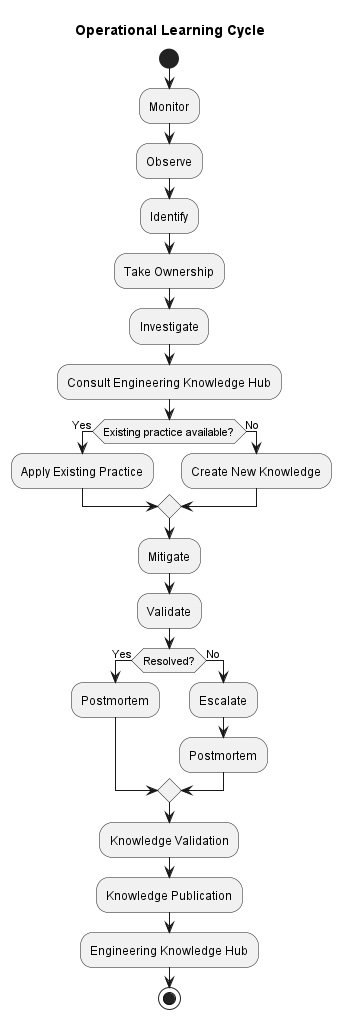
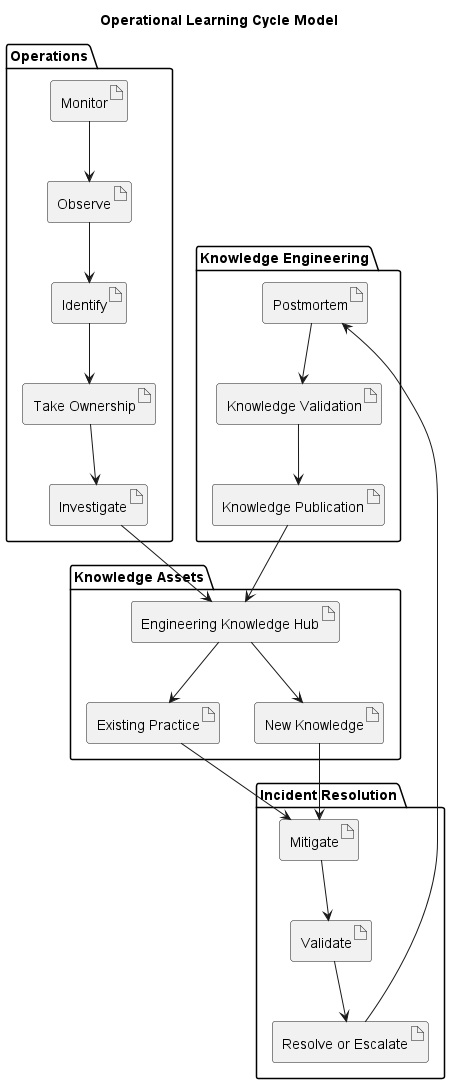
Knowledge should not remain exclusively inside tickets.
While tickets can serve as valuable sources of operational knowledge through detailed analysis, resolution steps, and contextual comments that support future similar cases, this knowledge should be transformed into reusable engineering capability.
Every completed engineering activity should leave the organization better prepared for the next one.
Every operational activity is both a consumer and a producer of engineering knowledge. The Engineering Knowledge Hub is therefore not merely a repository, but the central mechanism through which organizational learning is continuously accumulated, validated, and reused.
IV.2. The ZupportL5 Vision
How Can This Vision Be Implemented? (ZupportL5)
The initial motivation behind the ZupportL5 System was to improve support engineering by making operational experience reusable.
As the concept matured, it became evident that the underlying challenge was broader than ticket management.
The vision evolved toward an Engineering Knowledge Hub capable of supporting the complete Engineering Knowledge Management lifecycle.
Rather than replacing existing enterprise platforms, ZupportL5 complements them by connecting engineering knowledge across operational activities.
Its objective is to guide engineering knowledge through its complete lifecycle, from discovery to continuous improvement.
Potential capabilities include:
- Knowledge discovery
- Knowledge correlation
- Knowledge validation
- Knowledge standardization
- AI-assisted knowledge retrieval
- AI-assisted knowledge generation
- Knowledge lifecycle management
- Continuous improvement support
Conceptual Integration


The Engineering Knowledge Hub does not replace engineering judgment or experience; it strengthens engineering capability by making organizational knowledge reusable, accessible, easier to apply, and more reliable.
It amplifies engineering by preserving, organizing, and continuously improving engineering knowledge.
Conclusions
Engineering Knowledge Management provides a unified perspective in which every engineering activity simultaneously consumes existing knowledge and contributes to the continuous development of new organizational knowledge.
From this perspective, engineering knowledge is not a by-product of engineering work but one of its primary assets.
Thus, engineering organizations create value not only by solving immediate problems, but by continuously strengthening the ability to solve future engineering problems through the systematic management of engineering knowledge.
This perspective extends the traditional approaches to knowledge transfer, such as on-call handovers, transition meetings, or knowledge transfer (KT) sessions.
While these engineering practices remain valuable, they represent activities within the broader Engineering Knowledge Management cycle rather than the primary mechanism by which engineering knowledge is created, captured, preserved, organized, validated, transferred, applied, and continuously improved.
Engineering knowledge should not depend on the availability, memory, personal interpretation, or goodwill of particular individuals. Instead, it should continuously evolve through the Engineering Knowledge Management cycle, transforming experience into organizational engineering knowledge.
This principle is consistent with established engineering practices. Well-engineered artifacts should communicate the engineering knowledge they embody with sufficient clarity to be understood, applied, maintained, and improved by other individuals with minimal reliance on the original contributors.
Therefore, engineering knowledge should remain highly cohesive with the engineering artifacts it describes while remaining loosely coupled from specific repositories, individuals, or tools.
In software development, through appropriate design, structure, naming, and documentation where necessary, the code itself becomes a representation of engineering knowledge.
The same principle applies equally to architecture guidelines, operational procedures, runbooks, automation, standards, technical documentation, engineering models, and every other engineering artifact.
Work that remains isolated to a single engineering activity delivers value only once, whereas work that contributes to the Engineering Knowledge Management cycle extends its value beyond the immediate solution.
As organizational engineering knowledge accumulates, each engineering activity contributes to increasing the organization’s long-term engineering capability, enabling future engineering work to be performed more effectively, efficiently, consistently, and at greater scale.
The framework presented throughout this work can be summarized by the following principles:
- Engineering knowledge is one of the most valuable assets generated through engineering activities.
- Engineering practices represent validated approaches for solving recurring engineering problems.
- Engineering artifacts preserve, communicate, operationalize, govern, and support the automation of engineering knowledge.
- Engineering Knowledge Management transforms individual engineering experience into organizational engineering capability.
- Lifecycle consistency remains the same across disciplines; only the engineering inputs differ.
- Problems resolved are fully resolved only when the knowledge generated is integrated into the Engineering Knowledge Hub.
- Knowledge Hub provides the organizational foundation for preserving, integrating, and continuously improving engineering knowledge across disciplines.
- Continuous improvement depends on the continuous improvement of engineering knowledge.
- Automation is the natural progression of mature engineering practices.
- Abstractions expand the frontier of engineering and create the next generation of engineering problems.
- ZupportL5 represents one possible implementation of the Engineering Knowledge Management Framework, demonstrating how these principles can be operationalized through an integrated Engineering Knowledge Hub.
Reflective Questions
When consistently applied, this framework should provide guidance for answering questions such as the following:
- How much engineering knowledge was created, captured, preserved, validated, transferred, applied, or improved?
- How effectively was individual engineering knowledge transformed into organizational engineering knowledge?
- How broadly can the resulting engineering knowledge be applied across similar problems, systems, disciplines, or domains?
- How easily can another engineer understand, apply, maintain, extend, and improve the resulting engineering knowledge?
- How many future engineering problems could be prevented through the application of this knowledge?
- To what extent did it reduce future engineering effort, complexity, or resolution time?
- To what extent did it increase the organization’s engineering capability?
- To what extent did it reduce dependency on individual expertise?
- How effectively did it improve the organization’s ability to solve future engineering problems?
While the Fundamental Questions seek to understand the nature, origin, and evolution of engineering knowledge, the Reflective Questions encourage continual examination of how that knowledge is applied to strengthen organizational engineering capability. Together, they distinguish conceptual understanding from practical evaluation, establishing a foundation for continuous improvement and long-term effectiveness.
These questions are not meant to impose a universal model of measurement; rather, they serve to illustrate the vantage point established by this framework.
From this perspective, valuable insights emerge ─guiding the refinement of engineering methods, the strengthening of standards, the design of more reliable systems, and the creation of sustainable solutions that can adapt and endure alongside future engineering needs.
Future Work
Future work may further refine and extend the Engineering Knowledge Management Framework by:
- Formalizing the classification of engineering artifacts, practices, and knowledge assets
- Refining the Engineering Knowledge Management lifecycle and its underlying principles.
- Defining the conceptual relationships among engineering activities, knowledge, practices, standards, automation, and organizational capabilities.
- Developing conceptual, logical, and physical models for the Engineering Knowledge Hub.
- Applying the framework across additional engineering disciplines to further validate its generality and applicability.
- Implementing these concepts through the ZupportL5 system while continuously refining the framework through practical engineering experience and operational insights.
- Developing AI-assisted capabilities within ZupportL5 to support the discovery, validation, organization, and continuous improvement of engineering knowledg
Appendix A — Original Motivation: ZupportL5 User Stories
The Engineering Knowledge Management framework presented in this article emerged while exploring the design of the ZupportL5 System.
Initially, the objective was to improve support engineering through the systematic consolidation of operational knowledge enhancing engineering problem resolution. Over time, this practical objective naturally evolved into the framework presented in this work.
The following user stories represent a subset of the original requirements that ultimately motivated the development of the Engineering Knowledge Management Framework presented in this work.
Knowledge Preservation
As a Support Engineer, I want to access a centralized knowledge base so that I can quickly find relevant information to resolve issues.
Knowledge Operationalization
As a Support Engineer, I want workflow automation to execute runbooks that guide engineering best practices so that I can resolve issues efficiently and consistently.
Knowledge Transfer
As an On-call Engineer, I want a streamlined handover process so that I can transfer the current status of ongoing engineering activities without loss of operational knowledge or context.
Knowledge Discovery
As a Support Engineer, I want to quickly access historical information about similar engineering activities so that I can reuse previous knowledge and accelerate problem resolution.
AI-Assisted Knowledge Discovery
As a Support Engineer, I want a diagnostic capability that provides AI-assisted knowledge discovery so that I can identify potential solutions and root causes more efficiently.
Knowledge Integration
As a System Engineer, I want to integrate engineering knowledge with monitoring systems so that operational events contribute to the continuous Engineering Knowledge Management lifecycle.
Although originally defined as software requirements, these user stories reveal the core capabilities required by an Engineering Knowledge Management system. They illustrate the practical motivation that eventually evolved into the conceptual framework presented in this work.
Methodological Reflection
This work benefited from the use of artificial intelligence —specifically, a freely available one— as a collaborative tool for the refinement, articulation and organization of ideas.
While AI speeds up the communication of concepts, the framework presented in this work emerged through practical experience, engineering reasoning, reflection and continuous improvement of the underlying ideas.
Glossary
Architecture Decision Record (ADR) — A document that records significant engineering decisions and the rationale behind them.
Automation — The implementation of repeatable engineering practices through software or systems.
Continuous Improvement — The ongoing refinement of engineering knowledge, practices, processes, and tools through feedback and learning.
Engineering Activity — Any engineering work performed to design, implement, operate, maintain, investigate, improve, or support engineering systems. Engineering activities generate engineering knowledge regardless of the engineering discipline.
Engineering Artifact — A tangible representation of engineering knowledge used to communicate, preserve, govern, or operationalize engineering practices.
Engineering Completion — The state in which an engineering activity is considered fully resolved because the knowledge generated during its execution has been integrated into the Engineering Knowledge Hub, making it discoverable, reusable, and available for future engineering activities.
Engineering Input — The event, requirement, request, or condition that initiates an engineering activity. Engineering inputs vary across disciplines, but they all contribute to the Engineering Knowledge Management lifecycle.
Engineering Knowledge — The accumulated understanding, experience, and validated solutions generated through engineering activities.
Engineering Knowledge Asset — Any validated engineering knowledge that provides measurable value to the organization by supporting problem solving, decision making, standardization, automation, or continuous improvement.
Engineering Knowledge Hub — A centralized platform for discovering, managing, validating, integrating, and reusing engineering knowledge throughout the Engineering Knowledge Management lifecycle.
Engineering Knowledge Management — The discipline of creating, preserving, organizing, sharing, validating, and continuously improving engineering knowledge.
Engineering Knowledge Management Framework — A structured model that integrates engineering principles, operational processes, knowledge management practices, and platform capabilities into a unified approach for creating, preserving, and continuously improving engineering knowledge.
Engineering Practice — A validated and repeatable approach for solving recurring engineering problems.
Engineering Resolution — Completing the engineering lifecycle by preserving and propagating the knowledge generated during problem resolution.
Engineering Standard — A formally accepted engineering practice adopted to ensure consistency and quality.
Engineering Tool — A software system that assists or automates engineering activities.
Guide — A document that explains concepts, procedures, or recommended approaches.
Guideline — A recommended practice that provides direction without being mandatory.
Handbook — A curated reference that consolidates engineering knowledge within a specific domain.
Knowledge Base (KB) — A structured collection of reusable engineering knowledge.
Knowledge Propagation — The process of making engineering knowledge available and reusable across an organization.
Knowledge Validation — The process of verifying that engineering knowledge is accurate, reliable, and reusable.
Operational Resolution — Restoring normal operation after an engineering event or incident.
Operationalized — The process by which engineering knowledge is transformed from documented or implicit knowledge into an integral part of engineering activities. Once operationalized, knowledge no longer exists only as information—it actively guides decisions, defines practices and processes, supports execution, and can ultimately be standardized and automated.
Organizational Capability — The collective ability of an organization to consistently solve engineering problems through reusable engineering knowledge, practices, standards, automation, and tools.
Organizational Knowledge — Engineering knowledge that has been preserved, shared, and made reusable across the organization.
Pattern Recognition — The process of identifying similarities among recurring engineering problems and their solutions.
Playbook — A coordinated collection of procedures for responding to predefined engineering scenarios.
Postmortem — A structured analysis performed after an engineering event to capture lessons learned and opportunities for improvement.
Recurring Problem — A problem that appears repeatedly during engineering activities.
Repeatable Solution — A solution that consistently resolves the same recurring problem.
Runbook — A step-by-step operational procedure for performing a specific engineering task.
Version 1.0 | First Release | July 9, 2026
Version 1.1 | Reviewed Update | July 10, 2026
Version 1.2 | Structural Revision | July 11, 2026
Version 1.3 | Taxonomy Expansion | July 11, 2026
Version 1.4 | Engineering Role Responsibilities Added | July 20, 2026

 codingforwar
One thought on “Towards a Conceptual Framework for Engineering Knowledge Management v1.0”